Showing posts with label Pakistan. Show all posts

Wednesday, 13 November 2019

Kartarpur Corridor

Gurdawara Kartarpur Sahab, Pakistan
Inauguration of Kartarpur Corridor between Pakistan and India has been formally performed by Imran Khan, Prime Minister of Pakistan. Dr. Manmohan Singh, former Prime Minister of India, Captain Amarinder Singh, Chief Minister of Indian Punjab, Novjot Singh Sidhu, former test cricketer of India and Ajay Singh Deol aka Sunny Deol, Indian filmstar truned politician were the guests of honour alongwith hundreds of pilgrims from Sikh community who had travelled from Pakistan, India, UK, USA, and Canada to be witnesses and part of the history making occasion. Opening of Kartarpur Corridor was like a dream come true for Sikhs as they will now be able to have direct approach to visit the resting place of their founder guru, Gurudav Baba Nanak Sahab.
The event not only has a historic importance but also is of prime stratigic significance. Read the details of Kartarpur in urdu below: -


Saturday, 22 October 2016

What is PML (N) made of

Background

Pakistan was created under the leadership of All India Muslim League in 1947. All India Muslim League was single representative of Muslims of sub-continent with over whelming majority and support of people. Opposite Muslim political parties of that time like Nationalist Party and some politico-religious parties established by religious clerics were either in minority or opposed the idea of  division of India. With the legacy of being the founder political party, Muslim League has always been considered as a popular ideological political entity in Pakistan. People of Pakistan have traditionally had special affiliation to Muslim League for its political principles and objectives. With the same character, every military ruler of Pakistan introduced his own faction of Muslim League to establish political rule in Pakistan. Soon after the demise of its founder members, All India Muslim League; that had renamed itself as Pakistan Muslim League after independence, split into different factions till it was reunited and rejuvenated by Field Marshall Muhammad Ayub Khan, the first military ruler of Pakistan.
In 1971, after separation of Esat Pakistan (Now Bangladesh), Pakistan Peoples Party came into power with Zulfiqar Ali Bhutto as popular civilian ruler. During his reign, Pakistan Muslim League had almost disappeared till it was again reorganised by General Zia ul Haq for creating political activities during his military rule in mid 80s. Since then Pakistan's politics evolved into a two party party political system with Pakistan Peoples Party and Pakistan Muslim League taking turns in the government.

Creation of PML (N)

History

 In the early 80s, General Muhammad Zia ul Haq, after his military coup and take over in 1977, was forced to start political activities in the country. He evolved the methodology of strong presidential system in the country as himself being the Chief Martial Law Administrator and President of Islamic Republic of Pakistan with impotent parliament that could act as a rubber stamp to legitimate all his law making Presidential Orders. To assuage the overwhelming support and deep routed impact of Pakistan Peoples Party, on common people, in all the four provinces, General Zia ul Haq and his team studied the dynamics and worked out a strategy which left long impact on the political future of Pakistan. The steps taken under that strategy in all the four provinces were: -
  • Balochistan - Baloch nationalists were brought in lime light and united they were made part of Pakistan Muslim League.
  • Khyber Pakhtunkhwa (Then North Western Frontier Province) - Some of the religious clerics were made to form Pakistan Muslim League and other relatively staunch fundamentalists were added in Jamat Islami and Jamiat Ulema Islam (JUI) and their alliance was formulated as B team in case Muslim League failed to make any headway in the province.
  • Sindh (also spelled as Sind) - A considerable number of Urdu speaking community that had migrated to Pakistan on Independence settled in urban areas of Sindh. They always felt as they were deprived of their rights and were not satisfied with the power game in Sindh which was mostly in the hands of influential native landlords and Waderas (chieftains of local areas). Those migrants were united under the umbrella of Mohajir Qaumi Movement (MQM) and were made to rise against Peoples Party.
  • Punjab - A wealthy industrialist from Lahore was required to stand against the feudal chieftains and Chaudhrys who led Punjab politics. Lieutenant General Ghulam Jilani Khan, the then Governor of Punjab and a trusted deputy of General Zia ul Haq was tasked to search for such an industrialist. Initially he picked a leading industrialist and textile industry tycoon from Lahore named Shahzada Alam Monnoo (1936-2014) of Monnoo Group of Industries. Due to his lack of interest in politics and inclination towards social welfare work, he was dropped and Mian Muhammad Nawaz Shareef of Ittefaq Foundries was elevated as the first choice. Ambitious Nawaz Shareef stood to the call and thus was made part of Pakistan Muslim League. He was made Finance Minister of Punjab province and then Chief Minister. He remained Chief Minister of Punjab for two terms. Second term was under Benazir Bhutto of Pakistan Peoples Party, who was elected as Prime Minister of Pakistan after the military rule of Zia ul Haq ended.
In 1993, after the death of Muhammad Khan Junejo (1932-1993), the Prime Minister of Pakistan and President of Pakistan Muslim League under Zia's rule, Muslim League got split into two and a separate faction in Sindh already existed. Three main splits were: -
  • Pakistan Muslim League (Functional) PML (F) - under Syed Shah Mardan Shah (1943-2012) (Pir Pagaro) and was mostly active in Sindh being the spiritual leader of Hurs.
  • Pakistan Muslim League (Junejo) PML (J) - under Hamid Nasir Chattha (1944 -  ), who disagreed to the procedure of selection of Nawaz Shareef as President of Muslim League and parted ways.
  • Pakistan Muslim League (Nawaz) PML (N) - under Mian Muhammad Nawaz Shareef (1949 - ). On the demise of Muhammad Khan Junejo, Nawaz Shareef invited leaders of Pakistan Muslim League for tea at his residence in Islamabad. During the get together, he proposed his name as the new president of the party and since then the faction is named as Nawaz League or Pakistan Muslim League (Nawaz) abbreviated as PML (N) or PML-N. When General Pervez Musharraf took over after a successful military coup against Nawaz Shareef's government in 1999, Nawaz Shareef and his family went into self-exile after signing an agreement with Musharraf and Nawaz League split into two again, This time the parting faction was called Pakistan Muslim League (Quaid e Azam) PML (Q) under Chaudhry Shujja'at Hussain. PML (Q) joined hands with Musharraf and formed political government under his military rule.

 The Fibre of PML (N)

Pakistan Muslim League (Nawaz) has peculiar and some unprecedented features in its political formation as discussed below: -
  • Like previous Muslim Leagues, after creation of Pakistan, PML (N) was also given birth by a military dictator. Since its inception it lacked democratic culture within the party. The leaders once elected/ declared have never given away their authority and have treated the party as their family domain. Due to frequent and continuous rule in Punjab and in the Centre, the party has turned into a family dynasty.
  • As is a famous saying - Power corrupts and absolute power corrupts absolutely, the party has evolved a feudal  system in it where the leader is considered as above all sorts of laws and regulations. Words of the leader are considered as the final verdict and a binding over its policies. This feudal culture in the party has snatched away any rights of its members or the common followers to take part in any kind of policy making or decision process.
  • Before the creation of Nawaz League, corruption in politics was considered a moral crime but they are the pioneers to invent financial corruption and bribing elected members of national as well as provincial assemblies to vote for them. The term "Horse Trading" was invented for this and they started this rancorous tradition of buying the loyalties of elected representatives through heavy cash or favours in kind. They bought the loyalties of elected members of Punjab Provincial Assembly and also of National Assembly and literally kept in protective custody at Changa Manga and in a rest house in Murree till the time they voted for PML (N) in the assemblies.
  • Nepotism reached to its prime during the rule of PML (N). Due to the fears in his nature, Nawaz Shareef lacks trust on people whom he does not know well. For this reason, he is known for appointing his close relatives, family members and friends in the close circle at key appointments and ministries. This has failed the merit, capability and capacity standards of a democratic system. Entire statesmanship revolves around this group of people around him.
  • Leadership of PML (N) has a history of being rival to any one who they are threatened from. National institutions in their rule have been neutralized, penalized and even attacked. During his first term in office as Prime Minister, his party leaders attacked Supreme Court of Pakistan (SCP) and Chief Justice had to escape through window to save himself. He fired two services chiefs (Army Chief and Naval Chief). All appointments done at important institutions are out of merit or the heads are promoted out of turn, and/or left vacant. 
  • False and lucrative promises to public in political addresses is the common practice. Where ever Nawaz Shareef goes for public address, announces big developmental projects or relief packages but when the time passes, nothing material is done for the betterment of people.
  • All developmental projects are Punjab, specially Lahore based since Prime Minister Nawaz Shareef and his brother Chief Minister of Punjab Shahbaz Shareef belong to Lahore. This has created lot of resentment and discontentment in the people of other cities and provinces.
  • As a policy PML (N) prefers working the developmental projects that are visible on ground such as motorways, bridges, and over/ under passes etc. This is done to mention them during their election campaigns and during interviews to national and international media to boast upon. They pay no heed projects in health, education or social development because such expenditure is not visible on ground. This has deprived of people of basic health, education, employment and entertainment facilities.
  • Being from industrial background, they have run the affairs as a private franchise. Democracy to them is just to purchase votes at general elections and for the remaining five years in the government the country is run through aristocracy. 
  • To deal with the burning issues, PML (N) has evolved a policy of "being apathetic". On major issues they do not react when people look towards them for an official response. Recent examples are apprehension of a serving Indian military officer Kulboshan Singh Yadev, involved in espionage and supporting terrorists inside Pakistan's territory, Statements of Indian Prime Minister Narendra Modi about Indian involvement and contribution towards anti-state activities in Balochistan, evidences of involvement of Altaf Hussain of MQM in anti-state activities in Sindh and funding from Indian RAW.
Keeping the tendencies and attitude of PML (N) towards different issues and their methodology to deal with political issues, their mindset can be summed up in one line as: -
"Everything is for sale, you just have to offer appropriate bid to buy it".   

Tuesday, 18 October 2016

Imran Khan Locks Down Islamabad

PTI leader Imran Khan, in pursuit of stern action against Prime Minister Nawaz Shareef, having allegedly involved in corruption and illegal money trafficking, has announced locked down of the capital city Islamabad on 2 November. Isolated on political front and not being supported by opposition parties of the country, Imran Khan has taken intrepid decision to go for solo flight against the government and to bring the purported prime minister to justice.

Imran Khan had first decided to go for lock down of capital on 30 October (Sunday) but later, through consultations with party leaders extended it to 2nd November. He has put forth two demands and has announced that unless either of the demands is met, lock down shall continue. The demands are - either Nawaz Shareef shall resign from the office of premiership or he shall present himself for accountability. 

Imran Khan in close collaboration with Dr. Tahir ul Qadri of Pakistan Awami Tehreek (PAT) had fruitlessly sit in for almost four months in 2014 demanding resignation of Prime Minister Nawaz Shareef and had to quit due to non-persistent policies and demands. People lost interest and allegedly his ally Tahir ul Qadri had reached to an underhand deal with the government to end the sit in.
As soon as Panama papers were made public, it acted as a catalyst for Imran Khan who was already making hue and cry at every platform against the corruption and money laundering of Shareef family. Imran Khan immediately raised his voice and demanded stern accountability against the facts mentioned in Panama papers. His demanding reaction forced Nawaz Shareef to appear on national TV to address the nation twice as well as to make a speech in the parliament and clarify the allegations. Unfortunately his justifications on all the three occasions contradicted and lacked chronology of events. This caused further disappointment among the opposition and they wanted proper investigation of the charges levied against Nawaz Shareef and his family members.
Having failed to launch a combined movement of all the opposition parties, who parted away on one pretext or the other, and on cold response of Election Commission of Pakistan (ECP), National Accountability Bureau (NAB), Federal Investigation Agency (FIA), and Supreme Court of Pakistan (SCP), PTI decided to launch a solo show near Raiwind - the farm house and residence of Nawaz Shareef in the suburbs of Lahore. The show was extraordinarily outstanding and thousands of people showed up on the call of Imran Khan against Nawaz Shareef and family. Imran Khan, during his public address at the occasion announced locking down the capital so that functioning of government could be stopped under a corrupt premier. 
To neutralize the pressure of Imran Khan's demands, two steps have been immediately taken by the treasury benches. First, SCP decided to enlist the petition of PTI, against the alleged corruption of Nawaz Shareef, for hearing by the panel of justices. Second, Speaker of the National Assembly sent the reference of disqualification of Prime Minister to ECP on the plea of hiding the facts from the Parliament, thus being ineligible to hold the office of Prime Minister under the constitution of Pakistan. Both these steps are received by people as delaying tactics and to gain time through official procedures and file work.
Imran Khan has demanded one of the two steps and has announced that lock down of Islamabad will continue till one of the two demands are fulfilled. the two demands put forth by PTI are: -
  • Resignation of Nawaz Shareef from premiership.
  • Nawaz Shareef to present himself for accountability.
Both these demands are criticized by opponents based on past behavior of PTI and response of accountability institutions. Major criticism is:-

Demand of Resignation

In 2014 PTI had sat in Islamabad for more than four months for the demand of resignation of Prime Minister on the charges of corruption, nepotism in governmental departments and appointments of close relatives of Shareef family on key appointments, and adverse governance. After four months, taking the plea of attack on Army Public School Peshawar by terrorists, Imran Khan decided to wind up the sit in. After the sit in, the speeches made by Imran Khan at different occasions and his reaction on several national issues dictated that he has shown his failure in demand and was found unable to justify his stance of asking the resignation of the premier. He also reversed his decision of resigning from National Assembly and he, along with all his elected members came back to assembly. Due to his turnabouts it is perceived by serious circles that he will again fail his demand and will end his protest as long as people lose interest.

Prime Minister to present himself for Accountability

The foremost question to this demand is - present before who? NAB has already stated that accountability without evidences is beyond their constitutional purview. FIA is not empowered enough to take any positive steps. Lastly SCP has already announced that the petition against Nawaz Shareef will be heard by them. So what is the forum left where Imran Khan wants Nawaz Shareef to present himself? This question remains unanswered by Imran Khan and his party so this demand, in itself, becomes equivocal. According to Imran Khan himself, all governmental functionaries and key appointment holders are loyal and trusted meek employees of Nawaz Shareef, so to what institution is he asking Nawaz Shareef to present himself for accountability? In case SCP, NAB or FIA clears Nawaz Shareef of all the charges levied on him, will Imran Khan accept the decision and accept that Nawaz Shareef was not involved in money laundering, tax evasion, plundering of public money, and purchase of foreign properties without proper money trail of his wealth?

Besides the criticism on his demands, questions are also being raised on the permanency of his stand, extent and duration of his lock down, especially when he is going for it in isolation and no other political party; even his previous allies, are supporting his call. PTI has also to cater for the alternate courses if government uses power against them and house arrests its leaders to avoid public unrest.

This, in any case is the last chance for Imran Khan to remain in politics. If he fails this time, he will leave political playground wide open to PML-N (in other words Nawaz Shareef Family) because next general elections are due in My 2018 and there will be no challenging opposition for PML-N especially in Punjab, Khyber Pakhtunkhwa, and Balochistan. This will be fair enough opportunity for Nawaz Shareef and company to form governments in center as well as in said provinces.  

Saturday, 24 September 2016

Finally he spoke

Prime Minister Nawaz Shareef addressing UN General Assembly
Prime Minister Nawaz Shareef addressing UN General Assembly represented true feelings of people of Pakistan as well as of Jammu and Kashmir. Back home, known as a close friend of Narendra Modi of India, he faced a lot of criticism soon after he took oath as Prime Minister of Pakistan for the third time. His soft policies and friendlier attitude towards India was not liked by people of Pakistan. He was accused of preferring his business interests and personal ties with Modi and other business tycoons over national interests of Pakistan. At number of occasions his acts of kindness or silence were marked negatively at domestic front. Some of such occasions were: meeting with Indian top businessmen along with his son, when he visited India at oath taking ceremony of Modi, invitation to Modi to attend his granddaughter's marriage and treating him as state guest on the private ceremony, on the arrest of Kalboshan Yadev, a serving senior officer of Indian Navy, caught red handed in Balochistan, engaged in espionage operations, and during Indian violation of cease fire agreement in Kashmir.
Due to recent carnages in Indian Held Kashmir (IHK) by occupant Indian Army and killing of young Kashmiri freedom fighter Burhan Muzzaffar Wani, a fresh, indigenous  uprising for freedom has risen in IHK. To check this recent movement, Indian Army has launched grand scale operation in IHK killing more than a hundred innocent citizen and injuring so many. For the riots control, Indian Law Enforcing Agencies (LEAs) have used pallet guns that, when fired, spread pallets at the target injuring body, face and eyes. Around two hundred citizen have been blinded due to pallet injuries. Under these conditions, Prime Minister Nawaz Shareef was expected to raise his voice in UN so that Kashmir cause was highlighted to the world and comity of nations could be moved for the end of atrocities in Kashmir and grant right of self determination to people of Kashmir.
A couple of days before the speech of Nawaz Shareef was scheduled, India staged a drama in IHK. A raid was launched at an Infantry Brigade Headquarters in Uri area of IHK and immediately after the raid was executed, Indian leadership, armed forces and media started blaming Pakistan to have masterminded the raid. The claim of India was void of any material evidences but was a good try to nullify the effects of probable speech to be made by Nawaz Shareef.
Under these circumstances, when Prime Minister Nawaz Shareef was offered the pulpit to address UN General Assembly, he seemed thoroughly prepared to fight the case of Kashmir. He covered all the aspects of Kashmir issue and highlighted the brutalities being committed by Indian LEAs in Jammu and Kashmir. For the first time in his reign he seemed so openly speaking against India, while generally, he has always been known as  "tilted" towards India due to his personal business interests. Some of the strong points in his speech were: -
  • Reminding UN that Kashmir issue was the oldest unresolved problem in UN and people of Kashmir have been waiting the UN to fulfil her 70 years old promises made to them. 
  • Mentioning brutalities of Indian LEAs and the inhuman methods adopted by them to curb the freedom movement.
  • By name mentioning the killing of young freedom fighter leader Burhan Muzzaffar Wani and highlighting the fact that Indian Army was denying basic human rights of treatment, education, and civic facilities by imposing curfew in IHK, closure of schools, and paucity of food and grains.
  • Reassuring that Pakistan will keep supporting Kashmir cause and shall provide all diplomatic, ethical, and political support for their just demand of the right of self determination.
Prime Minister's speech was well received by all quarters in the country, however, some rightly pointed out the ways which could make it more fruitful and befitting to make the world understand how India was playing dirty in the region. Some valid observations about his address to UN are: -
  • It lacked emotions and was like mere paper reading without the involvement of inner feelings.
  • In his speech Prime Minister did not make a mention about Kalboshan Yadev and his active involvement in distress being tried in Balochistan.
  • He did not mention anything about Indian arrangements in Afghanistan against Pakistan and how India was trying to establish a nexus between Afghanistan and anti-state elements in Pakistan.
  • Funding of anti-Pakistan elements and pressure groups like Altaf Hussain club by RAW to make unrest in Karachi was not highlighted, despite having clear documentary and circumstantial evidences available at hand.
Besides these shortcoming, Nawaz Shareef was widely criticised of taking his family members along and making them sit as members of official delegate in the conferences he attended in USA. This could have been avoided and was totally unbecoming of a responsible statesman.
Where everyone appreciated the contents of his speech, it will be unjust if due mention and credit is not given to those who made him speak so openly against India: something unprecedented and unexpected from him. The credit must be given to: -
  • General Raheel Sharif and his team who not only briefed Prime Minister on all aspects of the situation but also got the speech drafted with the best and the most operative diplomatic language.
  • Pakistani political leadership and media who pressurized him to break his long overdue silence and openly present the case of Kashmir to the world.
  • Diplomats and especially the team in UN and USA who prepared and provided him the platform for his speech.
  • China, Turkey, and OIC who assured their full support for the Kashmir cause.
  • People of Pakistan who are wholeheartedly and ever ready to support people of Kashmir and have always stood shoulder to shoulder with them for their right to live they way they want as a free society.
  • Social media activists who contributed in pressurizing him to openly support people of Kashmir subject to Indian brutal firing and facing the hardships of shortage of food, water, medicines due to long enforced curfew.

Thursday, 17 December 2015

Remembering The Angels


16 December is a black day in the history of Pakistan. Before 2014, this day was observed as the day of Fall of Dhaka as East Pakistan was separated on 16 December 1971 from West Pakistan and was declared as a new state on the globe as Bangladesh. Bitterness of this deep wound and the pain was still felt in the hearts when after 43 years, in 2014, on the baleful day of 16 December, as many as nine terrorists attacked Army Public School and College (APS&C) Peshawar, opened point blank shooting and killed 231 students, 9 staff members including the Principal and 3 soldiers.

Declared as the most tragic terrorist attack in the history of Pakistan, all political parties, military leadership and the nation stood up for the final blow against terrorists and operation Zarb e Azb was launched with full thrust. Pakistan Army, Pakistan Air Force and Civil Armed Forces operating in Waziristan planned the operation and decided to fight the terrorism out till the last terrorist was eliminated.

Unfortunately, political government of Mian Muhammad Nawaz Shareef (Prime Minister of Pakistan and head of Pakistan Muslim League - Nawaz) was not willing to go for military operation against Taliban and they were in the process of delaying any such operation under the blanket of holding "peace talks" with Taliban. Immediately after the start of military operation on the initiative of General Raheel Sharif, Prime Minister had no choice but to appear before National Assembly and had to own and declare war on terrorists in his address.

Attack on APS&C Peshawar will be remembered in the history of Pakistan because of two reasons: -
  • Innocent children between the ages from 4 to 17 years were brutally massacred by boorish and barbaric terrorists. These little angels were assembled in school's auditorium for a demonstration on First Aid Training, as per their timetable. Terrorists fired each one of them in the head pointblank and had no mercy for the screaming and frightened kids. 
  • The effect of this unfortunate incident was so tenderheartedly felt by the nation that the unity and support for the young students and their teachers was unanimous. Whole of the community and all quarters got united and they demanded stern and quick blow back to terrorists. This kind of oneness and unity in public was not seen earlier save at the time of Pak-India War of 1965. Pakistani nationals all over the globe in general and pan-Pakistan in particular displayed focused strength through unity and indistinguishability and proved to international friends and foes that Pakistan is ONE SOLID BROTHERHOOD irrespective of how much they were wounded through terrorism, sectarianism, and political corruption.
Elite of the nation paying tribute to martyrs on 1st anniversary
 
Although a year has passed, the attack on school seems like the happening of yesterday. As soon as a memory of the incident is repeated in the mind, eyes get wet. As Pakistanis, we salute the parents of martyrs of APS for their patience and great sacrifice, we salute our Armed Forces for not letting the blood of innocent and tender flowers, and we salute the nation for showing all the support, backing and getting united.
Probably on any such moment of grief, the great poet Mirza Ghalib must have said,

سب کہاں کچھ لالہ و گل میں نمایاں ہو گئیں
خاک میں، کیا صورتیں ہوں گی، کہ پنہاں ہو گئیں

"all wherefore? just a few tulips-and-roses in manifested are
dust/dirt in-it what faces must-be that merged-hidden are"

Wednesday, 9 December 2015

General Raheel Sharif - The Essence


General Raheel Sharif is 15th Chief of Army Staff (COAS) of Pakistan Army. He was appointed as COAS on 27 November 2013 and is due to retire on completion of his tenure on 26 November 2016. Within two years in office as COAS, General Raheel Sharif has gained unprecedented support and backing of People of Pakistan. General took the charge as COAS when nation was in a state of pandemonium and uncertainty on different fronts. Terrorism was at its peak and suicidal attacks on every Friday had become a routine. Political government; instead of dealing with terrorists in the language they understood, was trying to hold peace talks with them. Situation in Karachi had gone worst, especially for business community who were beleaguered by extortionists and street criminals. Corruption in governmental institutions was at its peak and common people were exposed to unemployment, injustice, bad governance, and power crisis. 

General Raheel Sharif decided to fight against all social evils simultaneously and through concerted efforts of his team, he was not only able to gain control over most of the problems but also improved upon the general outlook of Pakistan internationally. He went head on at most challenging issues like terrorism in the country and law and order situation in Karachi. Immediately after taking over the command of Pakistan Army, he revised the methodology of military training and introduced more practical means in keeping the Armed Forces alert, trained, and ready for any combat operation. New weapons and equipment, specially to fight Close Quarter Battle (CQB) in Built Up Area (BUA), were developed and introduced for use by Infantry and Special Services Group (SSG).

On national front, General Raheel Sharif gained popularity as the most upright, brave, courageous, and firm leader within two years. This was made possible because of his revolutionary measures nationally and internationally to bring peace, stability, and improved foreign relations with other nations of the world. The gist of steps taken by him are as below: -
  • Start of Operation Zarb e Azb against Tehreek e Taliban Pakistan (TTP) and other terrorists who were operating through Afghanistan and Federally Administered Tribal Area (FATA) of Waziristan was their safe heaven.
  • Start of Rangers operation in Karachi against target killers, vehicles and cell phones/ jewellery snatchers, murderers, kidnappers, and terrorists. This resulted in bringing peace and stability in Karachi; the economic hub of Pakistan. For the first time in the history of Pakistan, big fish and mainstream political leaders have been questions and their close aides have been arrested. This operation brought life back to Karachi and public has overwhelmingly supported the actions taken by Rangers.
  • Prompt and courageous decisions like implementation of death penalty, establishment of Military Courts for prosecution of terrorists and anti-state elements. It has not only frightened such elements of rapid decisions and execution but has also provided relief and protection to civilian judges in the courts of law who were threatened and terrorized by the criminals. Terrorists who has attacked and murdered children at Army Public School and College Peshawar, caused fiasco at Safoora Chorangi in Karachi killing passengers of Ismailia community, and other such incidents have been hanged. 
  • Improvement and capacity building of Pakistan's nuclear and missile technology program. Successful test fire of FM 90 Missile has enhanced the capacity of Pakistan's strategic defense. Pakistan has become leading nation in the region in missile technology. IDEAS 2015 and other Defense exhibitions have provided new buyers of Pakistani weapons and war material to include JF Thunder (F-7 Fighter Aircraft). 
  • Revisit of Pakistan's foreign policy with his personal interest. Steps in this regard have played vital role in paradigm shift of national foreign policy to enable improvement in the diminishing image of Pakistan in the comity of nations. Pakistan's relations have improved many fold with USA, Russia, China, Europe, and countries of South America through his personal visits and determined focus on national objectives.
  • Solid and strong support and determined measures on ground to make China-Pakistan Economic Corridor (CPEC) a reality. Over and above Pakistan Government's agreements and signing of contracts, Pakistan Army, under the leadership of General Raheel has give surety to the neighboring sister country China for all kinds of protection, security, and peaceful work environment throughout the proposed corridor. This is the biggest project under foreign investment in the history of Pakistan and will bring job opportunities, industry, trade and prosperity nationwide.
  • General Raheel Sharif is a strong believer in Democratic System. Unlike previous instances of imposing martial law by his predecessors; during troubled times, he dealt with the situations with patience and provided opportunities to political leaders to resolve the issues. Keeping democratically elected government intact, he has always provided full backing of Pakistan Army for the continuity of civilian and elected representatives of people of Pakistan. 
  • For the first time, General Raheel Sharif implemented the process of accountability within Army. He dealt with the cases of corruption and misappropriation by senior officers in the Armed Forces and after thorough investigations/ inquiries, awarded severe punishments. This stern and bold action has been well received not only by all ranks of Pakistan Army but also by the civilian population. The mouths of those critics were also shut who used to bad mouth about the internal relaxation by Army Generals, whenever they started accountability of politicians, media, judiciary and civil bureaucracy.
  • Keeping the Armed Forces of Pakistan abreast with latest means of communication, he took revolutionary steps regarding civil-military relationships. Department of Inter Services Public Relations (ISPR); the institution to keep civilians informed about military, has been reshaped and improved. For the first time Officers of Armed Forces and ISPR in particular have been allowed, rather encouraged to use social media for enhanced interaction with public.
  • General Raheel has always responded to natural disasters not only in Pakistan but in the region. Pakistan Army has been ordered to respond to any untoward incident without waiting for formal instructions and initiative to deal with such situations has been delegated to lower command echelons of Armed Forces. He has always reached in person at sight of such mishaps and has lead from the front. Floods in Sawat, Earthquake in KPK and floods in Sindh are some of the examples. These are unprecedented examples and have given tremendous respect and support by people of Pakistan. In the region also, Pakistan has always been among the first nations to respond to any calls in the name of humanity. Pakistan Army's prompt response Nepal Earthquake is an example of such response.
  • Restoration of long suspended Defense Forces' Parade on 23rd March - In remembrance of 23 March 1940, when Resolution of Independence was passed at Lahore, is another very important courageous step taken by General Raheel. The parade was suspended due to Armed Forces' commitments in dealing with terrorists but restoration of parade has sent a vibe of security and stability to all Pakistanis.
Every individual has some personality traits which help him build the aura of every individual's outlook.  General Raheel Sharif carries the charisma of his personality, bravery, courage, uprightness but there is something more to all this that makes him so unique. General hails from a family that has military culture in his blood both from paternal and maternal side. His father, Major Sharif (late) was a profound officer. General Raheel's elder brother, Major Shabbir Sharif shaheed was a brave officer of Pakistan Army who was decorated twice. Due to his bravery and acts beyond the call of duty, he was awarded with Sitara e Jurr'at in Pak-India war 1965 and Nishan e Haider in Pak-India war of 1971. His maternal uncle, Major Raja Aziz Bhatti Shaheed was also awarded Nishan e Haider. It is the highest gallantry award of Pakistan and has been awarded to only 11 Officers/ Other Ranks so far. Two of those 11 brave heroes of Pakistan are blood relations of General Raheel. He not only has to keep up with the qualities required out of an Army Chief but he also carries the legacy of two Nishan e Haiders. That makes him an extraordinary General and an examplary leader.
Because of his personality traits and the legacy of his brother and uncle, it is expected that he will act with the same elegance and wisdom when he is asked for extension in his service as COAS. He has already gained the rapport as a man of principles and uprightness. It is expected that he will simply step down from his appointment on its completion and will leave an example for others to follow.

Tuesday, 17 November 2015

Paris Attaks, Background Straddled


Night 13-14 Nov was a tragic time in Paris when shooters and suicide bombers killed around 200 innocent citizens, leaving another 99 in critical condition. President Francois Hollande of French Republic declared these attacks as "An act of war against France". Terrorists selected 6 different soft targets to attack including a football stadium where a match was underway and was being witnessed by French President.

This act of brutality and terrorism is highly condemn-able and cannot be justified under any rationalization, whatsoever. Loss of lives of innocent children, women, and men is a collective loss of entire humanity, may it be in any part of the world. No religion, ethics, or human behavior allows or can justify such act of ruthlessness.

Apparently the responsibility of Paris attacks is accepted by ISIS; a terrorist militant group, active in Iraq and Syria but there is a need to analyze the incident more deeply, keeping in view some of the similar terrorist attacks in different parts of the world in the past. In the last three decades, our planet has seen severe surge of violence, intolerance, and terrorism. Its roots can be traced as back as the 50s to 70s era of cold war between USA and former USSR. Cold war had split the world in two major groups namely Capitalist bloc and Socialist bloc. At the face of it, the split seemed like two economic systems but in real these blocs were created in the hunt of power and supremacy against each other. This voracity caused a race of military might, ICBMs, WMDs and other lethal nuclear and NBC arsenal. Countries included in respective blocs signed mutual agreements of military defense namely NATO and WARSA pacts and undertook to mutually fight against any attacker. Besides building on military might, signing agreements of safeguarding mutual interests on economical fronts, and issuing guarantees to protect each other, a lot of covert activities started in opposite blocs as well as within the blocs. These activities included espionage through intelligence agents, scientific/ electronic monitoring and planting moles. These activities were two fold, one: to gain timely intelligence of opponents activities and two: to keep a check over own allies and ensure they were not in any sort of secret contact with opponent bloc. This kind of constant watch over allies was also necessary because besides political and geographical ideologies of different countries; who had joined a specific bloc, their religious and social cultures and attachments forced them to have relationships with countries in other bloc. Such dogma was more common in Arabic and Middle Eastern states as those were split in both blocs but were yet united being Arab/ Muslim states.

After USSR's invasion of Afghanistan in 1979, the situation worsened and NATO bloc proactively struck against the invasion. As a result of NATO's efforts, USSR not only withdrew from Afghanistan but also split into pieces. On the other hand, through passive support of USSR; in opposition to USA, Islamic revolution overthrew the rule of Pehlavi dynasty in Iran, who under the reign of Raza Shah Pehlavi, was a strong ally and the biggest protector of USA's interests in the region. USA considered these events in Afghanistan and Iran as transformation of geopolitical situation in Middle East (ME). After disintegration of USSR and claiming to be the sole super power in the world, USA decided to alter the paradigm to keep the region under her invulnerable control in future.

USA had sought help of Pakistan, Kingdom of Saudi Arabia (KSA), Afghanistan and other Muslim countries by naming the fight against USSR in Afghanistan as Jehad (holy war of Islam) against pagan/ atheist oppressor. This moved religious pressure groups to enroll young men in private militia and through USA funding, Islamic seminaries were established to train the youth in war craft, especially guerrilla warfare. These trained militia were named as Taliban and were launched in Afghanistan to fight against USSR Army. USA provided them arms, ammunition, food, shelter and financial aid through the puppet military regime of Zia ul Haq. These Taliban were sponsored through rich business and interest partners of USA in KSA and other Islamic countries e.g., Bin Laden Group of Saudi Arabia who were partners of USA top leadership in oil exploration and extraction. Osama bin Laden, an employee of CIA was made in-charge of aid program to Taliban and was sent to operate in Afghanistan. After the withdrawal of Russia from Afghanistan, USA disregarded Taliban in Afghanistan and wanted to rule the country through a dummy, moderate, and incompetent ruler of Kabul. Taliban revolted against USA at this point and demanded their right to rule Afghanistan which they claimed to have earned through their physical participation in war to defeat USSR. USA in turn declared Taliban as terrorists (which were earlier labelled by her as Jihadis - Holy warriors of Islam). Osama bin Laden, seeing the transposed view of USA founded an Arabic based extremist group and named it as Al-Qaeda. He, through his vast financial resources, enrolled Arabic, Chechen, Uzbek, and other radical Muslims to form a rigid group who rejected to accept any other faction or jurisprudence of Islam and declared all other Muslims as Kafir (non-believers).

In Iran, USA lost her grip as soon as Islamic revolution was enforced, which was covertly supported by USSR. This caused general hatred against USA and a soft and sympathetic corner for USSR in the hearts of Iranians. USA did not accept this change and wanted to carry out her covert operations to regain her hold in the region. This time USA decided to activate 1400 old rift between Muslims in the name of sectarianism. KSA and Iran are very old rivals and their rivalry is rooted back to the times of Umar bin Al-Khattab, the second Caliph of Islam. It was during his time that Islamic forces of Arab peninsula attacked and captured Faris (present day Iran that was a super power of that time). The rivalry of both countries kept going till present day because KSA was ruled by Aal e Saud (Saud dynasty) who followed Wahabi jurisprudence of Islam where as in Iran Shia jurisprudence of Islam is followed. Wahabi and Shia factions of Islam has major differences in belief and these create a rift between the two sects. USA and her allies decided to start a proxy war in Pakistan and Afghanistan and further spread it to all the countries where Shia and Wahabi split was present. This would help the cause of USA and Western world as they were to obtain following goals:; -
  • Immediate hold on oil and natural resources of Middle Eastern states.
  • Gain control in Afghanistan and Pakistan to keep a check over China and Iran.
  • Keep Iran pitched in uncongenial and troubled situation against Saudi Arabia and other ME states.
  • Ensure that Muslim Arab states remain busy in sectarian violence so that the state of Israel; surrounded by Muslim states, is safeguarded.
  • Put a check on speedy spread of Islam in the West and create a wave of hatred amongst Muslims and natives of Western countries so that vast migration/ emigration of Muslims can be controlled.
  • Control spread of Islamic seminaries and Mosques in the West. 
  • Weaken Muslims through internal disputes and polemicise to the extent that they indulge in bloodshed.
  • Keep Muslims away from modern education, science, and technology by propagating only the rituals of prayers, fasting and other practices as the total purpose of religion, through planned course by foreign funded and sponsored religious clerics.
  • Keep tyrant and illegal monarchs imposed over people so that Muslims remain oppressed, poor, uneducated and enslaved.
  • Make them afraid of performing their religious obligations and making them believe that religion is a private affair. This is aimed to be achieved through demolishing holy and sacred places like tombs of Prophets, Family and Companions of Prophet Muhammad on the one hand and by bomb explosions, suicidal attacks etc on Mosques and Imam Bargahs.
To achieve above goals, a heavy sectarian war was imposed in the ME and religious extremists organizations like Hizb ut Tehreer, ISIS, Al-Qaeda, Taliban were funded and supported to fulfill above goals in different Islamic countries. 

Recent attacks in France have been owned by ISIS after two days, while international leadership and media had already started associating them with ISIS. This is not unprecedented as similar tactics was used after 9/11 in the US when the blame was ultimately accepted by Al-Qaeda. USA needed an excuse to launch physical attack and take control of Kabul so that Taliban were pitched in the battle in the name of "War on Terror" and puppet government of Hamid Karzai could be installed. In Iraq the legitimacy of NATO attack was bluffed on the plea of destruction of WMDs, Iraq was building up but till date no weapons of that sort have been recovered from Iraq where as about fifty thousand people have lost their lives in the war and post war Shia-Sunni conflicts. At the cost of blood of innocent civilians and state of unrest and uncertainty, USA, however has gained full control over Iraqi Oil and state resources.

To turn ME spring into autumn, USA/ NATO went further deep and raised armed and trained organizations like ISIS to fight against the governments in ME/ Arabian states. These militants were funded and equipped by the West to fight and create unrest in favor of USA/ NATO. This is a matter of serious concern that ISIS is being supported in Syria to fight against the government forces where as the same terrorist organization is opposed in Iraq.

In the west, in the name of "freedom of expression", incidents like publishing cartoons of Prophet Muhammad, burning of copies of Quran; holy book of Islam, and putting restrictions on observing hijab by Muslim women were supported by the governments. This attitude created a wave of hatred among Muslims of the world and they felt that such incidents were against the honor, respect, and sanctity of protocols of Islam. West must understand that becoming Policemen of the world, creating rift between different factions and sects of any religion, planting and nurturing radical fundamentalists and supporting/ aiding bloodshed will always have its negative fallout. It is a universal truth that "what goes around, comes around".

Although the loss of innocent citizens in Paris attacks are high condemned, the producers and suppliers of arms and ammunition to terrorists must notice that the blood of innocent women, children, senior citizens and young people is as precious as the blood of people who died in 9/11 attacks in USA or recently in France. Let the peace prevail and stop aiding/ supporting terrorist organizations operating in any part of the world otherwise, "what shall you sow, so shall you reap."        

Thursday, 12 November 2015

Role of Madrassah in Pakistan


With the upsurge of terrorist activities in the country, madaris (Islamic seminaries) (plural of madrassah) have come under enormous criticism of nurturing terrorists. Since most of the terrorist activities in Pakistan and Afghanistan have their linkage with religious enthusiasts, it has provided ample opportunities for anti-Islamic activists to condemn madaris with ample and tangible evidence. No one can deny the fact that some of the madaris have been proactively involved in training of their students in use of arms, explosives, and have acted as nurseries of producing terrorists. There are yet a few which, apparently have not involved in direct armed training but have indulged in brainwashing young minds to create hatred against those who do not follow their faction of religious beliefs. But it is highly unjustified to object to madaris in totality as they are serving as alternate welfare institutions in the country.

Historically, madrassah has been an institution of formal religious and scientific sciences and its tradition can be traced as back as in the time of Islamic state in Medina. The first madrassah is believed to be established jointly by Hazrat Ali ibn Abi Talib (companion and son in law of Prophet Muhammad) and Hazrat Abdullah ibn Abbas (companion and cousin of Ali and Prophet Muhammad) - May Allah's peace be upon them. The institution of madrassah has played an important role during the golden times of Islam. Famous early Muslim astronomers, biologists, nutritionists, chemists, economists, geographers, mathematicians, doctors, political scientists, and scholars were the product of madaris of their times. Many madrassah students were employed by the rulers in their courts for statecraft and were appointed to the ranks of prime ministers and chief justices.

As Islam spread in different parts of the globe, the institution of madrassah also traveled with Muslim traders, invaders, and preachers. In subcontinent madaris were established right after the Muslim conquest of Sindh and Multan. Although in the beginning these institutions were informally established by Sufis and preachers on local levels and adopted ways and means suiting local population. Proper madrassahs were later instilled during the times of Muslim rulers of Delhi and later during Mughal rule of India. During the rule of Muslims in subcontinent, state machinery and bureaucracy was based on scholars, statesmen, engineers, judges, doctors, and political scientists, who were graduated from Islamic seminaries. After unsuccessful revolt of 1857 against British rule, British took over the control of India and made it their colony under the viceroy appointed directly by Queen. In British India, all degrees awarded by madaris were declared null and void and the government announced that only those persons, well versed with English language and modern sciences were eligible to get government jobs. This created a clear demarcation between madrassah education and modern schools.

Three of the major types of madaris in subcontinent were established as Darul Uloom Deoband (Devbandi Sunni University, estb 1866), Madrassah Manzar e Islam, Bareilly (Islamic University of Brailvi Muslims, estb 1904), and Bara Imambara Lucknow (where Hawza Ilmiya Lucknow (Islamic University of Shia Muslims) was estb in 1791). At independence in 1947, there were only 189 madaris in Pakistan which grew to 783 in 1971. After Iranian Islamic (Shia) revolution and Russian invasion of Afghanistan during very late decade of 70s, Pakistan was inundated with madaris and training of militant wings became as part of madrassahs education. During this time Pakistani madaris of particular factions; mostly Wahabis and Deobandis, were funded for following reasons: -
  • Prepare militants to fight against USSR in Afghanistan in the name of Jehad e Islami (Islamic holy war) against paganism - a strategic move by USA to fund and replenish human resource for using them in Afghanistan.
  • There was a threat that Islamic revolution in neighboring Iran might expand in other Muslim countries of the region This speculative expansion was against the interests of USA and Saudi Arabia. Both provided free resources to madaris of Deobandi and Wahabi factions for countering expansion of Islamic revolution. New madaris with grand buildings and ecellent facilities were built, religious scholars were provided with latest amenities of life, transport and protocol.
  • General Zia ul Haq had imposed martial law in the country and he wanted to gain public support. He used the name of Islam for this purpose as people in subcontinent are raditionally very sentimental about religion. Through the support of US and KSA funding, he paid high amounts to religious clerics for his nefarious political and religious designs.
Jamaati Ulama Islam ... figured as a fairly minor part of Pakistan's religious scene until the regime of General Zia al-Haq ... who used an Islamic policy to buttress his military dictatorship. Part of his policy to `Islamize` Pakistan was a campaign to expand religious education with funds for thousands of new madrases. Their number grew from around 900 in 1971 to over 8000 official ones and another 25,000 unofficial ones in 1988. With financial support from Saudi Arabia, Deobandi madrasas were part of this vast proliferation in religious education, much of it located in Afghan refugee camps that sprang up in the 1980s. This rapid expansion came at the expense of doctrinal coherence as there were not enough qualified teachers to staff all the new schools. Quite a few teachers did not discern between tribal values of their ethnic group, the Pushtuns and the religious ideals. The result was an interpretation of Islam that blended Pushtun ideals and Deobandi views, precisely the hallmark of the Taliban.    
--- The Wahabi Mission and Saudi Arabia by David Commins (2009), p:191-2

This caused sectarianism, hatred, and militancy in relatively moderate and peaceful Pakistani society where Muslims of all sects lived in the past with mutual tolerance and brotherhood. Wikileaks, based on reliable evidence has published a detailed report on Saudi financed Wahabi madaris. The report is an evidence of how different political and religious proxy wars have been fought in pan-Pakistan areas and has left their long damaging impacts.

     
Beside the clear evidences of involvement in militancy, recruiting terrorists, brainwashing and spreading hate, and training the youth in handling arms and explosives by some madaris, the importance of madaris can not be undermined keeping in view the the socioeconomic situation of Pakistan.

Pakistan is the land of 21 Million people and official reports suggest that only 2.1% of total GDP is being expended in education sector. With deteriorating data of children enrolled in governmental schools, increasing drop out rate due to poverty and limited access to schools/ teachers, lot of children of the school going age; especially in rural areas, are left out of schools. Madaris, under these circumstances, act as alternate and parallel system to share the burden of government. Madaris not only act as seminaries but registered madaris also impart education of science, computer, and other modern sciences. These madaris are run under governmental control and have to submit their syllabi for approval. Such madaris provide boarding and lodging facilities to students as well as financial assistance to the poor families. Thus they are a source of providing support which a welfare state shall provide to its citizen. With the introduction of modern sciences as part of the syllabus of madaris, the degrees awarded to madaris graduates are recognized by HEC and such degree holders are provided with equal job opportunities in all sectors of central and provincial government jobs.

Till the time Government of Pakistan (GOP) is unable to provide food, shelter, health, and education facilities to all of her citizen, the role of madaris is very vital in supporting the poor and middle classes of population. The need is that a prudent monitoring system be employed to ensure that following is ensured to keep madaris free of any anti-state/ anti-Islamic activities:-
  • Source of funding to madaris to ensure no funding (local or funding) is done to support any sort of proxy wars.
  • Regular and professional external audit of accounts of madaris to ensure every penny donated to madaris is accounted for.
  • Vigilant supervision to check that madaris are imparting training of peace, brotherhood, and equality on humanity, instead of spreading hate against other sects/ religions.
  • Syllabus is prepared to broaden the minds of students and to create a sense of patriotism, loyalty, national integrity and mutual co-existence of society.
  • Besides religious education, knowledge of modern sciences and foreign languages like English, French, German, Arabic, and Persian are also imparted.
  • All chances of training for militancy, supporting terrorism or extremist approach is curbed with iron hands.  

Monday, 26 October 2015

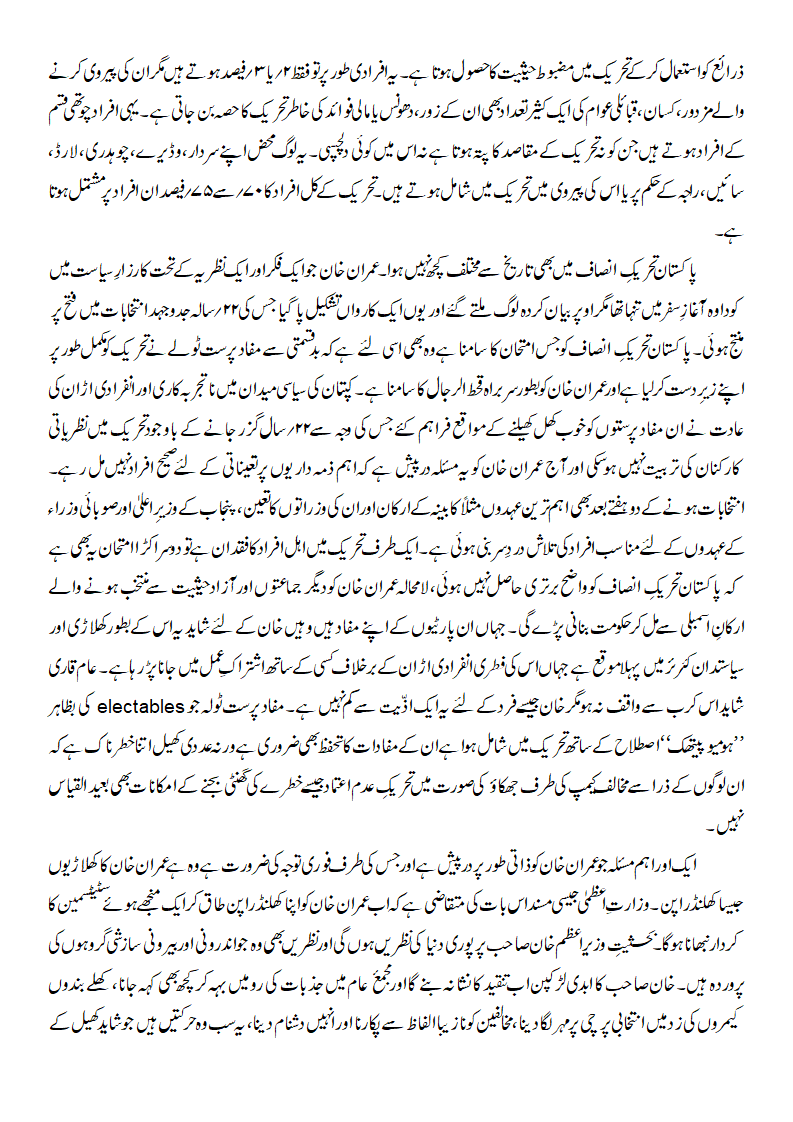
Making of PTI

Imran Khan of Pakistan Tehrik e Insaf (PTI)
Pakistan Tehreek e Insaf (PTI) has effectively gained the position of a 3rd force in a political system of two parties in Pakistan. There are a number of factors that have played their role in bringing such a success to Pakistan Tehreek e Insaf. Some of the facts are driven by Imran Khan (born 1952) of PTI, whereas some are such ground realities of contemporary politics parties that have shifted the weight in favor of Pakistan Tehreek e Insaf. Both factors are enumerated as strengths of PTI and weaknesses of other parties: -

Strengths of PTI

Personality Charisma of Imran Khan 

Imran Khan carries the legacy of his cricketing career. Pakistan won the only ICC Cricket World Cup under his captaincy and before he entered in politics he had a rapport of an hero. Besides his brilliant cricketing career, he also constructed Shaukat Khanum Memorial Cancer Hospital through charity. His funds collection campaign was well received by the masses and Pakistanis, not only in Pakistan but also in foreign countries supported the noble cause and gave him donations even out of the way. He is handsome, has a charming personality and carries an elegant aroma. In his youth he was a popular young man who was idealized by males and was a dream man for many women all over the world. 
His charming personality, talent in cricket and altruist activities made him a popular figure, especially in the urban areas of Khyber Pakhtunkhwah, Punjab and Sindh. At early stages of political career, PTI revolved around this single factor and all the following PTI got was because of Imran Khan's personality. Mostly those who joined him were young, infamous, and ambitious people.

Personal Traits as Party Head

Although there have been some negative observations about Imran Khan in his personal capacity and his private life, his reputation as a party head/ national leader has always been upright. He is considered to be an honest, fair, and just leader whose hands are not polluted of any sort of corruption or financial embezzlement. Although his critics say that he has not been blamed of any venality because he has never been tested at any public office throughout his life. But whatever conduct he has displayed as a cricketer or as a philanthropist does suggest that given a chance, he will stand by his rapport.

PTI Targeted Youth

Since inception, Pakistan Tehreek e Insaf has large following of youth in the urban areas. Imran Khan realized this fact at the onset and exploited it in the interest of his party. During early stages of his political struggle, they were only the infamous young boys and girls who supported him, worked in his cause and gave basic shape to party's edifice.

Selective Membership of Party

In the start the strength of Pakistan Tehreek e Insaf was that membership in general and party offices in particular were given to only those people who were not involved in any corruption or malpractices. This brought good name to the party and raised the hopes of common people that an honest alternate leadership was being introduced. Unfortunately, as the time passed,  PTI could not stick to its basic ideology and after a successful show of power at Iqbal Park Lahore in October 2011, doors of PTI were opened for everyone. Most of the politicians who were discarded by their previous parties, charged of corruption, and rejected by people joined PTI and ultimately pocketed party's lead positions in their pockets.

Slogan of "Building New Pakistan"

Imran Khan, famous for his cricket captaincy and social works (Shaukat Khanam Cancer Hospital and Namal Educational project), gave new hope to people of Pakistan in the shape of ending long ongoing War on Terror, equal educational opportunities for all, justice at common man's door step, and corruption free social and governmental system. Collectively he gave it the name of "Building New Pakistan". People in Pakistan, who were sick and tired of terrorism, different education systems for rich and poor classes, corruption of politicians and governmental machinery, and unjust and lengthy legal system, overwhelmingly supported PTI for this hope of change.

Vibrant Methodology to Attract Public

Instead of using conventional, orthodox and formal means of addressing public gatherings and delivering scripted speeches, PTI introduced new and vibrant methods to include resonant music, emotionally high-pitched ostentatious speeches, and use of street language; which was considered as against the norms. This created excitement in youth and they were always hyped to attend such public gatherings. Such mood and atmosphere changed PTI's public gatherings into eventful festivity and a source of entertainment.

Weaknesses of Other Parties

These were not only the strengths of PTI and its leadership that rose the party to its present eminence but there are some external factors or weaknesses of other political parties that led to the success of PTI. Some of the factors are listed below: -

Pakistan Peoples' Party

Mr. Asif Zardari, co-chairman of Pakistan Peoples Party, had number of times repeated a sentence of his wife Mohtarma Benazir Bhutto (late) that Democracy was the best Revenge. To prove it right, the best revenge he took was from Pakistan Peoples Party itself. Peoples Party; in the times of Zulfiqar Ali Bhutto and Benazir Bhutto, was known as a single political force that was symbol of federation in all provinces of Pakistan. It had deep rooted influence in urban and rural areas in all the four provinces, Gilgit-Baltistan, Kashmir, and FATA. Asif Zardari, through his corruption, nepotism, and sheer mismanagement of governance; during PPP's rule from 2008 to 2013, squeezed PPP countrywide and trammelled it as a political pressure group in rural areas of Sindh province only.
In 2008 General Elections, PPP won majority sympathy votes after the murder of Benazir Bhutto and formed a coalition government in center, Khyber Pakhtunkwah, Balochistan and Sindh. Peoples' Party had deep roots in farmer and workers class since its inception as its founder and former President/ Prime Minister of Pakistan, Zulfiqar Ali Bhutto gave socialistic philosophy and his slogan of roti (food), kapra (clothes), and makan (shelter for living) got overwhelming popularity in poor class of Pakistani masses. Zardari government from 2008 to 2013 failed to address any problems of common people. Pakistan was facing severe energy crises, terrorism and unemployment. Governmental institutions were at the verge of bankruptcy. Pakistan Railways, Pakistan International Airlines Corporation, Pakistan Steel Mills, Oil and Gas Development Company, Water and Power Development Authority, Sui Northern and Sui Southern Gas Companies, and State Bank of Pakistan had deteriorated to the extent of failure. People were subjected to social injustice, unemployment was at its prime, corruption and bribery was common in all governmental departments, hospitals and institutions of public health were in shambles, education system was counter productive. Political leaders did not address any issues of public and never tried to provide any relief or solution to the miseries of people. This worsened the social system in Pakistan while Zardari and his gang remained busy in plundering national wealth for private gains.
Due to the poor performance and apathetic approach towards resolve of peoples' concerns, a big leadership vacuum was created by PPP in most parts of the country. Pakistan Tehreek e Insaf; due to its slogan of "New Pakistan" and hope for change filled in this gap successfully.

Pakistan Muslim League (Nawaz)

Leadership of PML-N to include Mian Nawaz Shareef and Mian Shahbaz Sharif were exiled during the tenure of Pervez Musharraf. They were eager to return to the country at all cost. During the military regime Nawaz Shareef of PML-N and Benazir Bhutto of PPP signed an accord named Charter of Democracy (COD). According to COD both parties reached at an agreement to safeguard democracy in Pakistan and to take measures to prevent any future adventure by military Generals to topple democratically elected governments in Pakistan. At the face of it, COD looked as an impressive document for stability of democracy but practically it proved to be a mutual agreement of protection of personal benefits of both the parties. PML-N, during Zardari regime from 2008- 2013, acted in such a way that they were known as "friendly" opposition in the Parliament. They fully cooperated with PPP in the center and ruled in Punjab. Despite few political movements and street politics against PPP government's policies, they never posed any serious opposition in the parliament. In real, both parties had decided to take turns in power for one tenure of five years with Punjab being with PML-N and rural Sindh with PPP.
Before exile, Nawaz Shareef and Shahbaz Shareef also tried to mobilize people in Punjab province under the slogan of Jaag Punjabi Jaag (O Punjabis, wake up). This was to make Punjabis stand up for their rights and to make them aware that other provinces; under the garb of being poor, were eating up national resources unjustly. This did not get major support in Punjab but created a serious wave of hatred for Punjabis in the hearts of Balochis, Pakhtuns, and Sindhis. PML-N, due to its friendly opposition and Jaag Punjabi Jaag kind of hateful approach lost its support in most parts of the country. In Punjab, PML-N ruled for 5 times but they concentrated on development of Lahore major cities of Punjab, especially Lahore: the native city of Nawaz Shareef and Shahbaz Shareef. This adversely effected their popularity in Southern and Central Punjab that comprises of poor and farmer class of people living mostly in rural areas.
Leadership of PML-N consisted of businessmen and their anti-farmer policies restricted their support to major cities like Lahore, Rawalpindi, and Faisalabad only. PML-N, once posing serious threat to PPP remained confined to urban areas of Punjab only. This also favored PTI to gain popularity, especially in the Pashtun and Hazara areas of Khyber-Pakhtunkhwah.

Muttahida Qaumi Movement (MQM)

In Urban areas of Sindh, especially in Karachi, Hyderabad and Mirpur Khas, MQM had achieved politically monopolistic majority since majority of population in these areas were Mohajirs (migrants) from India at the time of independence in 1947. Altaf Hussain, the founder leader of MQM; while being in self-exile in UK, led his party successfully till 2008. Thereafter, due to his bad health, internal politics of the party, and his alleged involvement in anti-state activities loosened his grip over the party affairs. His public telephonic addresses in the recent past put oil to the burning flame. He is also facing interrogation in UK for the charges of murder of his former colleague, Dr. Imran Farooq as well as charges of being involved in money laundering.
On MQM's petition to launch an operation in Karachi by Army was acceded to by the federal government and Sindh Rangers (a segment of Civil Armed Forces) were tasked to start a neutral but intense operation across the board to restore peace in protracted turbulent port city of Karachi. More Pakistan Rangers dug the ground realities, more criminal activities of MQM were revealed. MQM was found guilty of criminal activities to the tune of providing protection to prosecuted fugitive criminals at their headquarters called 90. Rangers also apprehended serial and target killers who confessed that they were part of MQM and had indulged in criminal murders on the orders of top MQM leadership.
In the recent past, the speeches of Altaf Hussain were so poisonous and harmful to the state that court had to put a ban on his public appearance in media, broadcast of his address or any other form of reaching out to public. This has helped PTI to appear as alternate political force in urban areas of Sindh. Although MQM has deep roots and if MQM leadership decides to carry out their political activities with minus Altaf formula accepted, they can still keep PTI out of political business in urban areas.    
Protected by Copyscape